 Seven
Hills
Seven
Hills
Images and Signs of the 21st Century
II ) Jungle
Cries and Whispers (Room
2)
There seems to be an immeasurable diversity of species and shapes in the plant and animal kingdoms. Researchers around the globe are working to take stock of biodiversity. They want to record all of the planet's species, only a fraction of which are known to humankind. However, humans only manage to record excerpts from the vast complexity of life when observing nature and seeking to represent nature. There is as much diversity to be found in how nature is seen and expressed in art as there is in the natural world itself. In seeking to document the diversity of life, scientists and artists made a contributions to natural history as well as to the history of art. Nature is valued nowadays not just for its intrinsic value but also for its economic worth, both as a source of medical progress and as the wellspring of aesthetic sensibility. Whilst conservationists first and foremost stress the value of life per se, many pharmaceutical companies see the rain forests as a genetic and economic resource just waiting to be exploited.
Gene's Animal Farm (Room 3)
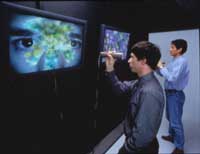 In
previous eras, illustrations of living beings were static and purely descriptive.
At first, this approach seemed to offer sufficient scope to record the
whole panoply of nature. Many artists also busied themselves sketching
the broad gamut of living creatures, seeking to satiate the collector's
itch of both private individuals and scientific institutions. Although
many exotic beings could not be preserved indefinitely, there was nonetheless
a desire to produce as precise a documentary record of them as possible.
In
previous eras, illustrations of living beings were static and purely descriptive.
At first, this approach seemed to offer sufficient scope to record the
whole panoply of nature. Many artists also busied themselves sketching
the broad gamut of living creatures, seeking to satiate the collector's
itch of both private individuals and scientific institutions. Although
many exotic beings could not be preserved indefinitely, there was nonetheless
a desire to produce as precise a documentary record of them as possible.
This first approach contrasts with
contemporary technologies, which can look deep into the inner life of
living beings. They reveal microscopic details and make it possible to
view vital biological processes unfolding over time. And biotechnology
is about to form and manipulate life itself. Whereas once artists served
biology, research results now often filter through into the arts. Simulations
of evolution, for example, are the basis for artificial life in multimedia
art. A new alliance between art and science is emerging: the work is no
longer a static unit but is subject instead to constant change just like
life itself.
Whale Affinities (Room 4)
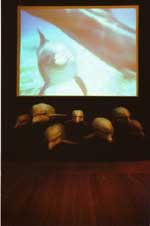 How
much of humans is to be found in animals and how much of animals is there
in humans? It is virtually impossible to define exactly where the thin
borderline between human and animal runs. One might even ask if the question
still makes sense in the light of modern behavioural research. 18th
century philosophers had heated debates about whether animals have a soul,
yet in 19 th century zoological literature it was taken for
granted that they did. Nowadays scientists seem to stress the similarity
between animals and people more than ever. It has long been demonstrated
that animals can use tools, engage in complex learning processes and employ
a simple form of language. Dolphins, for example, make differentiated
sounds and live in complex social structures. Chimpanzees can communicate
with humans using sign language. In genetic terms, even insects, on the
whole not very popular creatures, are more closely related to us than
we generally assume. Will biologists in the future find the specific genes
that make us human? And what repercussions will that have for mankinds'
sense of identity?
How
much of humans is to be found in animals and how much of animals is there
in humans? It is virtually impossible to define exactly where the thin
borderline between human and animal runs. One might even ask if the question
still makes sense in the light of modern behavioural research. 18th
century philosophers had heated debates about whether animals have a soul,
yet in 19 th century zoological literature it was taken for
granted that they did. Nowadays scientists seem to stress the similarity
between animals and people more than ever. It has long been demonstrated
that animals can use tools, engage in complex learning processes and employ
a simple form of language. Dolphins, for example, make differentiated
sounds and live in complex social structures. Chimpanzees can communicate
with humans using sign language. In genetic terms, even insects, on the
whole not very popular creatures, are more closely related to us than
we generally assume. Will biologists in the future find the specific genes
that make us human? And what repercussions will that have for mankinds'
sense of identity?
The Eyes of the Goddess (Room 5)
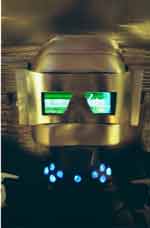 The
Indian goddess Kali unites opposing aspects of becoming, preserving and
destroying. These contradictory forces are taken here as a metaphor for
humans' relationship to nature. The name Kali is derived from Kala, meaning
time, which creates and devours everything. Tradition holds that the goddess
was called into life in a battle against demons. She possesses uncontrollable
forces and everything to do with her behaviour is extreme. On the one
hand, the black goddess is elevated to the status of saviour of the universe
and the gods call for her aid. On the other hand, she may begin to wipe
out the whole world in a destructive frenzy. The only thing that can stop
her is the god Shiva, in the form of an new-born baby, the symbol of a
new beginning. The great mother symbolises the frightening aspects of
nature and promises to protect those who honour her. She is thus both
attractive and repulsive. Like nature, Kali is above human morality. Diverse
facets of the dreadfully beautiful goddess are illustrated in historic
depictions in sculptures, paintings and miniatures.
The
Indian goddess Kali unites opposing aspects of becoming, preserving and
destroying. These contradictory forces are taken here as a metaphor for
humans' relationship to nature. The name Kali is derived from Kala, meaning
time, which creates and devours everything. Tradition holds that the goddess
was called into life in a battle against demons. She possesses uncontrollable
forces and everything to do with her behaviour is extreme. On the one
hand, the black goddess is elevated to the status of saviour of the universe
and the gods call for her aid. On the other hand, she may begin to wipe
out the whole world in a destructive frenzy. The only thing that can stop
her is the god Shiva, in the form of an new-born baby, the symbol of a
new beginning. The great mother symbolises the frightening aspects of
nature and promises to protect those who honour her. She is thus both
attractive and repulsive. Like nature, Kali is above human morality. Diverse
facets of the dreadfully beautiful goddess are illustrated in historic
depictions in sculptures, paintings and miniatures.
Cats and Chats / Tiger in the Net (Room 6)
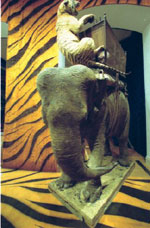 Here,
the tiger represents all endangered species a symbol of nature under threat.
Three of the eight tiger sub-species are already extinct, and there are
only a few hundred of each of the remaining five sub-species at least
in the wild. Although the tiger may not survive the next century in the
wild, zoos around the globe have successfully bred tigers. This illustrates
how the work done by zoos has changed: nowadays zoos are not simply showing
animals to the public but also engage in species conservation.
Hi-tech medical techniques using sperm banks and artificial insemination
allow targeted breeding. The World Tiger Breeding Book kept by Leipzig
Zoo serves as a basis for global gene-pool management. In contrast, images
from the colonial age, historic paintings and taxidermic specimens evoke
a sense of fascination, unfettered power, savagery and exoticism. Various
tiger body parts, destined for consumption in one form or another, fetch
a high price on the black market. In some countries people still believe
that consuming products derived from various parts of the tiger lends
special powers.
Here,
the tiger represents all endangered species a symbol of nature under threat.
Three of the eight tiger sub-species are already extinct, and there are
only a few hundred of each of the remaining five sub-species at least
in the wild. Although the tiger may not survive the next century in the
wild, zoos around the globe have successfully bred tigers. This illustrates
how the work done by zoos has changed: nowadays zoos are not simply showing
animals to the public but also engage in species conservation.
Hi-tech medical techniques using sperm banks and artificial insemination
allow targeted breeding. The World Tiger Breeding Book kept by Leipzig
Zoo serves as a basis for global gene-pool management. In contrast, images
from the colonial age, historic paintings and taxidermic specimens evoke
a sense of fascination, unfettered power, savagery and exoticism. Various
tiger body parts, destined for consumption in one form or another, fetch
a high price on the black market. In some countries people still believe
that consuming products derived from various parts of the tiger lends
special powers.
Nature in the Drawer (Room 7)
Scientific natural history collections are
the descendants of the 16th century European Wunderkammer .
There, works of art were shown alongside natural objects and other kinds
of curiosities. In 1735 Carl von Linn devised the first general systematology
for the plant and animal kingdom, which laid the foundation for museums
of natural history. This grammar allowed to name all living creatures
in a universally comprehensible language. Biological collections today
still use the same principles. The type of a species is the most important
element underpinning this system, and is used like a kind of yardstick
as a reference point for researchers around the globe. Only the type proves
the scientific existence of a particular species.
In the future there will be a growing
number of gene-banks, with animal semen and plant seeds, as a sort of
genetic back-up. Genomic banks store the genes that have been isolated
as millions of tiny fragments. Is this a kind of virtual Noah's Ark to
preserve bio-diversity?
Continue to the next hill: Cosmos


© Berliner Festspiele GmbH
Letzte Änderung: 19. Juni 2000